A POTTED ISLAND HISTORY
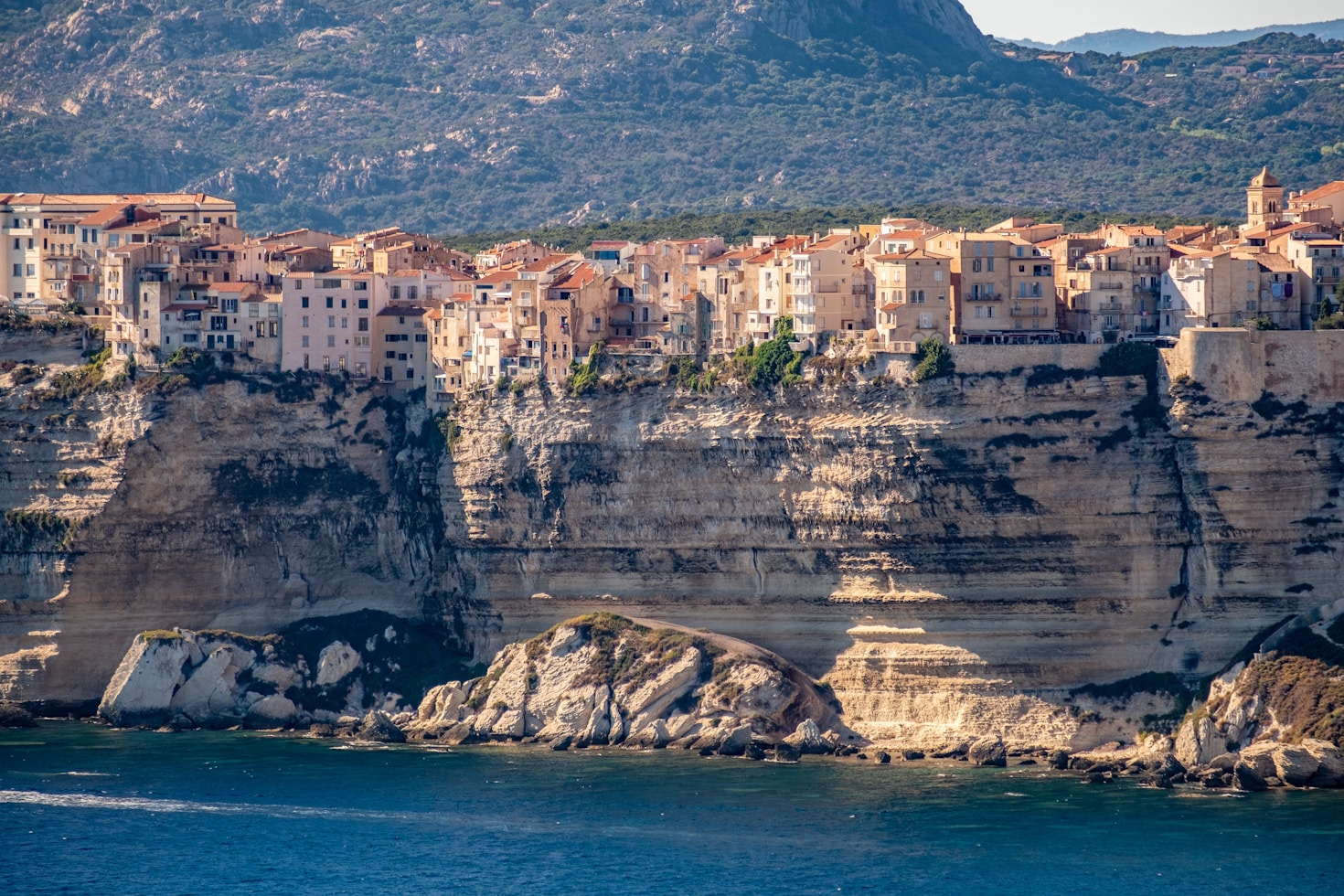
The ‘Île de Beauté’ (beautiful island) by the French and ‘Kalliste’ (beautiful) by the Greeks, Corsica is also referred to as a, ‘mountain in the sea’. Sitting amid translucent unpolluted waters, it is situated 125 kilometres south of the Gulf of Genoa, 82kilometres west of the Italian coast (with Elba in between), a stone’s throw, 12kilometres, from Sardinia and 450 kilometres east of Spain. Due undoubtedly to its strategic position in the Mediterranean it has been constantly invaded, fought over and occupied by different peoples.
Ancient invaders included the Greeks who founded the town of Alalia (now called Aleria) on the East Coast in 540 BC, and introduced vines, olive trees and cereals to the island, the Etruscans, the Greeks again before the Carthaginians. In 260 BC the Romans arrived and eventually, a century later, conquered the whole island. They stayed until the fall of the Empire when in the fifth and sixth centuries AD, the Vandals, Ostragoths and Byzantines moved in, to be succeeded by the Lombards. They didn’t stay long and the island was put under Papal protection, which unfortunately didn’t stop the Saracens from launching attacks and incursions over the next three centuries.
In 1077 the Bishop of Pisa was sent to exercise Papal authority over the island, an authority that continued for two centuries, in spite of conflicts with the Genoese and between Genoa and the Kingdom of Aragon for regional surpremacy.
Genoa prevailed and ruled Corsica until 1729 when the Corsicans rebelled and sought independence. Years of fighting followed with even the British joining in. Finally in 1768, the year preceding Napoleon Bonaparte’s birth, Corsica became French.
From even this extremely potted history of Corsica, it is evident that many different influences were brought to bear on the cuisine of the island. Those readers who wish to know more of the topography and historic background can immerse themselves in Corsica’s rich bibliography.
“On Corsica I was given life, and with that life I was also given a fierce love for this my ill-starred homeland and fierce desire for her independance. I too shall one day be a ‘Paoli’.” Napoleon Bonaparte
CLIMATE AND TOPOGRAPHY
An important aspect of agriculture on the island is the fact that Corsica is the only island in the Mediterranean with a high rainfall; more in fact than that of the Paris region. The rain falls mainly in the mountain ranges, which have fifty peaks of over 2000 metres, (of which the highest is Monte Cinto at 2706 metres), providing natural irrigation through the many torrents and rivers that run down to the sea.
Add to this the temperate climate with plenty of sunshine and you have ideal conditions for cultivating the soil, although the fact that a lot of the island is made up of granite rockface limits somewhat the extent of arable soil.
From the permanently snowcapped top of Monte Cinto, down through forests of Maritime and Laricio pines, chestnut forests, orchards and olive groves and, finishing at sea level with palm trees and cactus plants, an enormous variety of plant life can be found in Corsica. Of the more than 2800 species of flowering plants found on the island, 300 are native.
But perhaps the most important consideration is that over one third of the land is now a nature reserve, the ‘Parc Naturel Regional de la Corse’. No intensive pig farming here with its accompanying pollution. Instead all efforts are being made to guarantee that the traditional methods are maintained and that produce from the island has its own label of quality and authenticity.


PEOPLE AND PLACES
Corsica has a population of around 360,000, well over half of whom live in the three major coastal towns of Ajaccio, Bastia and Porto-Vecchio. Readers will see from the names of dishes and foodstuffs that I have given at the heads of recipes, that the Corsican language is alive and well, although the mainland government made every effort to annihilate it in favour of French. It is now fully accepted and is taught in schools. There are some variations in spelling from one part of the island to another, and different words too, will be employed.
The migration to the coasts and desertion of the mountain villages, particularly from the beginning of the 20th century, intensified after the Second World War, when the American army sprayed the mosquito infested east coastline with DDT, ridding the area of the dreaded malaria that had affected it for so long. As the coast became increasingly populated, so the villages emptied save for the elderly who retired to their family homes, and certain stalwarts who clung to the traditional way of life.
In the summer the villages come to life again as a large part of the population of the two main towns, Ajaccio and Bastia, escape the heat of the coast and install themselves in their ancestral homes in the mountains. Corsicans from the mainland come home for their annual summer holidays and also for the major religious festivals, Christmas, Easter and All Saint’s Day.
THE CORSICAN KITCHEN
Traditional dishes are prepared for these feast days, often varying from one village to another. The recipes are not written down but passed from one generation to the next. They are usually learnt as the children help their mothers or aunts in the kitchen, although the men are often just as knowledgeable as the women in the matter of cooking.
Until the middle of the twentieth century cookery in the villages was based on local produce. People ate what they grew and reared in their gardens and smallholdings as the seasons changed. Food was preserved for the winter by drying, salting, pickling and smoking. Half the house was given over to the storing of food. Dried fruits, chestnuts, pulses and cereals in the attic, and hams, sausages, oil, cheeses, wine in barrels, honey and jams in the cellars.
Most of the cooking was done over the open fire although dishes were sometimes baked in the communal bread oven in the village. On fete days no cooking was undertaken, everything having been prepared beforehand.
Meals were prepared according to what was in season and generally followed a weekly pattern. Although the preparations were fairly simple, pride was taken in the quality and freshness of ingredients and ingenuity shown in the use of the abundant choice of herbs that grow wild all over the island.
Nothing went to waste, a glut of tomatoes in the summer would be left to ferment in wooden barrels for a few days to drain the fruit of their acid and the resultant purée salted and spread on wooden boards in the sun until it darkened in colour. Then it would be stored in earthenware pots and covered with a film of olive oil, to be used during the winter months.
Bread was baked once a week in the communal oven of the village. Stale bread was used to make a soup of bouillon, garlic and slices of bread sprinkled with grated cheese. Often the evening meal was simply a bowl of soup followed by cheese and, sometimes, dried fruit, though the soup in question was usually a hearty vegetable soup flavoured with a ham bone and thickened with pasta.
Until the beginning of the nineteenth century most islanders, apart from the very rich, ate fresh meat only on special occasions. Cabri (milk fed goat) was considered the finest meat and was served at Christmas time. Milk fed lamb was also highly rated and was usually eaten at Easter.
The Corsicans have been shepherds for centuries and still follow the practice of transhumance; moving the flocks of sheep or goats to the mountain pastures for the summer and back down to the plains and valleys to spend the winter. The animals are kept for their milk, which is used to make remarkable cheeses flavoured with the herbs on which the animals have fed.